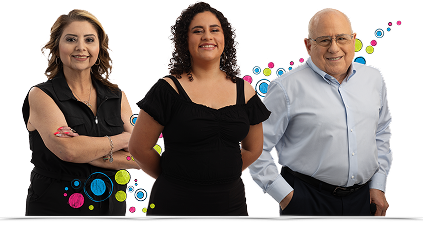
EF: Hi, I'm doctor Eliana Fine. Thank you so much for
joining me today to have this wonderful conversation. Can you please
introduce yourselves and tell me a little bit about you?
RM: Hi, I'm Roxanne Martinez, I'm from San Antonio, Texas,
and I have Gaucher disease type one.
EF: Nice to meet you.
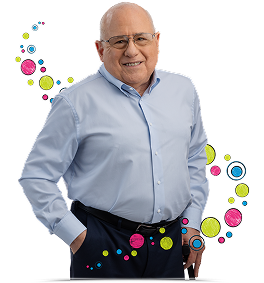
WR: Hi. Nice to meet you. My name is Wayne Rosenfield. I'm
originally from Springfield, Massachusetts, now living in the Tampa Bay area
with my wife. Academically and professionally I'm a psychologist, and I am
living with type one Gaucher disease.
EF: Nice to meet you as well. Can you guys share with me
what you know about the inheritance of Gaucher disease.
RM: Well, from my understanding, I know that both parents
have to at least be carriers of the GD1.
EF: Yeah. So we call that autosomal recessive. And so when
one parent is a carrier and they have a child with another parent that is a
carrier, they would have a 25% chance of the child having a disease and
about a 50% chance of their child being a carrier of the disease. Have any
of your family undergone testing for Gaucher disease?
WR: Oh, yeah. Well, we know that both of my kids are
obligate carriers. My wife was tested before we had children, and she's not
a carrier. So we know that the children can't possibly have Gaucher, but are
carriers. I've had some members of my extended family, cousins, aunts and
uncles, who have been tested and there's a surprising number of people who
came out positive for carrying the GD mutation.
EF: Oh, wow. What about in your family Roxanne?
RM: Actually, both my parents never were tested. My sister
was the first one to be tested, and that's how we discovered the actual GD1
in our family, cause she was the first one to discover that she has the GD1,
the disease. And then, my brother does not have it, but he is a carrier. And
then, my sister's two boys were tested, and they both are carriers. I have
two sons, and my oldest son was never tested. My youngest son was tested,
and he's a carrier, but my oldest son, that was never tested, his son does
have GD1.
EF: Okay, so then he must be a carrier as well.
RM: Yes.
EF: What triggered both of your families to start testing
for Gaucher disease?
RM: Actually my sister, when she was younger always had
signs and symptoms.
EF: So once your sister got tested, you got tested.
RM: Then I became – then I was positive.
EF: That probably made everything make sense after that.
RM: Yes. [Interview clip] Actually, what happened was through my sister. My
sister, when she was pregnant, she ended up miscarrying. And they told her
that she had to go see an oncologist. And then she had to go have a bone
marrow test. And through her bone marrow test is where they found she had
the Gaucher. And then from the Gaucher diagnosis, they told her, have the
rest of your family tested, and it trickled that way. And so, then I was
tested and that's when I found out I was positive.
EF: What about you, Wayne?
WR: Well, in my case, extended family testing was a result
of my own positive diagnosis of Gaucher disease. At this point, the family
members were interested. Like, what's going on? And I was very forthcoming
with them about what was going on with me and how it was relevant to them.
And since then, I've had contact with other cousins who were planning
children, and I made sure that they knew this is something in our family.
Just pay attention to it. It's not something to worry about, but you need to
know about this.
EF: I always encourage patients to come for pre-conception
counseling when they are interested in getting pregnant, whether or not they
have family members that have a genetic disorder in their family like
Gaucher disease. I think having that early conversation's important. I work
in a very large Orthodox Jewish community, and many of my patients do
private carrier screening pre-marital before they even get married to the
person. There's a really well known organization that's wonderful called Dor Yeshorim
that provides genetic testing for girls and boys before they are of marriageable age.
And then when they become of marriageable age, a lot of them will see, are they a match?
Meaning, are they going out with someone who has different genetic testing than they do?
Where if they both carry the same disease, then they wouldn't be a match and they wouldn't
continue to go out and get married. So the issue is, is that Gaucher disease is not
part of that testing.
WR: Oh no.
EF: But at least having that conversation is important because patients need
to be able to make informed decision and say, hey, this is what you were tested for.
Do you want to get tested for other things? Do you know about other diseases out
there that you may be at risk for?
Wayne, can you share with me how you went about talking to your wife's OBGYN. When you were considering to have a family.
WR: My wife got tested after we were married.
EF: Okay.
WR: She, she converted to Judaism. So she doesn't come from Ashkenazi genetic heritage. So that wasn't a
consideration for me. We decided that she would be tested anyway. But it came out clearly that she was an unaffected range.
EF: Okay.
WR: Since then, there's been genetic testing. She does not have a mutation in that gene.
There's no way our children can have Gaucher disease, although they are obligate carriers because
I have Gaucher disease, I have the double recessive.
EF: Yeah. Do you find that, having spoken to genetic counsellors and understanding your
risk of passing along the disease, did that provide information for you in order to, like,
help make those decisions in terms of family planning?
RM: Well, back home, we haven't found any genetic
counsellors who know anything about it, so...
EF: Oh my goodness.
RM: It's not, you know, other than my doctor.
EF: Yeah.
RM: You know, no genetic counselors have been able to help or know enough to be able
to explain to my children or my brother or talk to them about genetic counseling or anything like that.
So, they're, they live with that fear, with that constant fear.
EF: That must be really tough. I think it's hard when you have a rare disease that is
not very prevalent in the communities that you live in, and that makes it a little bit more tough in
terms of finding providers, whether it's a physician or genetic counselor, to be able to, like, really
educate you about the disease, the disease process and expectations.
Would you have found pre-conception counseling of any benefit in terms of if someone were able to, like,
walk you through your risk of passing along the disease and different options, whether that means not having
children or having a child with understanding that there's a potential risk the child could be a carrier or could
have the disease, or pursuing IVF and PGT. Is that something that you would have found helpful?
RM: I think so, cause I think in the Hispanic community, you know, they're so, you know, stubborn
when it comes to doctors and, you know, things like that. And don't, it's just different.
[Interview clip] I just wish that they would make the genetic testing something that either is not so much mandated,
but more widely offered, or something that is easier, easier accessible to, to mothers or couples because like,
for example, my brother, now he's a carrier, but he is now afraid to have a baby because he doesn't want to risk it having GD.
EF: It's also hard to find someone that you can trust. I think in in certain places.
So yes, it's definitely a need for more education and awareness.
RM: Yes, yes, yes.
WR: Yeah.
EF: I want to highlight the regular monitoring of signs and symptoms at home is really important in order to
guide your care. As physicians, we want patients to come to us with questions, with new symptoms that they may be experiencing,
to be able to understand, is that due to Gaucher disease? What are the options that we have available to help you?
And I'm curious from you guys, what have you done to monitor your signs and symptoms at home?
WR: I see a Gaucher specialist, annually, and I travel, and we do a very comprehensive exam with MRIs and DEXA and,
looking at my heart, and lots and lots of laboratory testing, testing for the, the major biomarkers for Gaucher. So I've been extremely vigilant.
EF: Roxanne, what about you? How do you monitor your signs
and symptoms at home?
RM: I see my primary care doctor every three months and I do my lab. I, do lab works, my lab work every three months as well,
and she monitors that, and she sends it to my, GD doctor, my specialist as well. And I see him every six months.
And do my, labs, my GD labs, also at that time, every six months, at that time. And then I do my DEXAs and stuff every year.
EF: I think it really shows the importance of having a full
team of doctors from different specialties to be able to help you navigate
the different signs and symptoms that present due to Gaucher disease.
RM: Yes.
EF: You both mentioned that you have Gaucher specialists.
What type of physicians are they? Are they primary care doctors? Are they rheumatologists?
RM: My specialist is a pediatric geneticist.
EF: Oh, wow. Wow, wow. What about you?
WR: I didn't realize that I was going to be the one to say the same answer. I see a pediatric geneticist, and you go and you sit in this little furniture.
RM: Yeah.
WR: Well, with the with the pediatric geneticist is well versed. She has genetics counselors there. I speak with them.
They understand and I have nothing I need to educate them about. I'm able to talk about myself.
EF: Yeah.
WR: And their questions are very incisive and to the point and very, very relevant. My Gaucher specialist is internal medicine,
and liver and gastroenterology is his primary specialty, and he has a special interest in Gaucher. He's the one who's informing a lot of my treatment.
At the recommendation of my Gaucher specialist, I also see an endocrinologist to deal with bone mass, which has been one of my issues.
My primary Gaucher involvement has been skeletal. Not completely, but I've had other things happen. But, skeletal involvement.
EF: What advice would you give young patients
who are newly diagnosed with Gaucher?
WR: Well, what I would say is embrace it.
Don't be afraid of it. It's, you're a member of a community that is special, that is select. I have a friend in the Gaucher community who said one time, well,
you really don't want to have Gaucher disease, but if you do, the best part is the people you meet and, and I repeat that, and I thought, well, actually, that's really true.
And, you know, hearing, hearing Roxanne, talk about her situation. You know, where she's rocking it. And this is information that you can use, the information that you have this,
it's information that you can use to get out there, be part of life, and do what you need to do. But, but denying it and ignoring it. I don't think so.
WR: [Interview clip] But what I want to convey to people who are not on treatment is, just based on my experience, you're at the edge of a cliff.
You don't know how close you are to that cliff. I've had a very small number of high-intensity events, and each one of them was completely unforeseen.
I'm going along, everything is great, boom, I'm in too much pain, I can't move.
I wish I had had in those days the benefit of what we know now.
EF: What about you, Roxanne? What advice would you give?
RM: I would just say to get out there and just be part of the community of GCA, and learn as much as you can about it.
And don't be afraid to reach out to members of the community. And don't be afraid to, to, like Wayne said, embrace what you have and, and just take,
take like, take the bull by the horn and, and don't be afraid, and you're going to get through it. And, and just live, live life to the fullest.
If my, my grandbaby can do it, anybody can.
EF: Yeah. In terms of the guidance that I like to give my patients that have Gaucher disease is to advocate for themselves,
to understand the different signs and symptoms that they can present with, and just talk to their provider about it.
Really not just having patients ignore their symptoms, pushing it off, making excuses for it. Sometimes the symptoms are real. They're always real,
but sometimes there's something that we can do about it and as long as patients will take that step to, like, let us know about it and not just push it under the rug,
I think that's huge. And I really try to empower patients to do that.
Do you find that in the Ashkenazi Jewish community that
there's a lot of awareness about Gaucher disease?
WR: Well, I don't have formal empirical polling data, but informally, anecdotally, I don't think anybody I don't I'm not hearing it.
I'm not seeing awareness. When I've asked people, they, they say, no, I know about it because of you. Thank you very much.
But, you know, no. I don't think there's a lot of awareness. And again, this isn't empirical polling data.
EF: Right.
WR: This is my, my overall impression. I try to educate people, and I'm kind of, out about it. But I don't know of anybody else who can say that there's really great awareness.
EF: Yeah. Roxanne in your circle, in your community, how well
known is GD1 disease?
RM: Not known at all. The one person that I did encounter
that knew what it was, was an oncologist that I went and took my mom to go
see. I was surprised. She was the one person that knew what it was.
VPRIV (velaglucerase alfa) for injection is a prescription medication indicated for long-term enzyme-replacement therapy (ERT) for patients with type 1 Gaucher disease.
Important safety information. Life-threatening hypersensitivity reactions, including anaphylaxis may occur with VPRIV treatment.
This reaction may occur early in treatment or after many doses. Seek immediate help if you experience wheezing, shortness of breath,
trouble breathing, itching, hives, rapid heartbeat, swelling of the tongue or throat. VPRIV should be administered under the
supervision of a healthcare professional. Appropriate medical support should be available when VPRIV is administered.
Please keep watching for additional Important Safety Information and find the full Prescribing Information located on this website.
EF: Wayne can you tell me a little bit about why you chose
treatment and what treatment you chose?
WR: Well, interesting question. I've had a very relatively low number of high-intensity events related to my Gaucher disease.
I required very little encouragement to convince me that I needed to be treating this disorder. This is the cause of a lot of pain, a lot of heartache,
and a lot of disruption in my life. So, my doctor recommended VPRIV, which is also known as velaglucerase alfa, for injection.
And my understanding is that it's a prescription medication indicated for long-term enzyme replacement therapy, or what we affectionately call ERT,
for patients with type one Gaucher disease. So, before choosing VPRIV and following my doctor's recommendation, we discussed, I discussed with him,
the potential benefits and risks of VPRIV so that I was fully aware of them.
I came to understand that VPRIV does have some risks, such as hypersensitivity reactions, including serious allergic reactions or anaphylaxis.
The most commonly reported side effects are hypersensitivity reactions, headache, dizziness, abdominal pain, nausea, back pain, joint pain,
increased time it takes for blood to clot, tiredness, weakness, and fever. So I'm fully aware that those are the potential side effects.
So I felt that I needed to be treated. My doctor and I agreed and I went ahead with beginning VPRIV.
EF: Wow, what about your journey to treatment, Roxanne? What led to your decision to start treatment with VPRIV?
RM: Well, after, of course, my sister being diagnosed and going with her to see the specialist and just hearing how much he knew about Gaucher.
He just was a genius. I, my sister and I just felt he was a genius. So, just he just laid out all the different treatment options there was.
And my sister and I talked about it, and she decided VPRIV was best for her, so that's what she started on. And then after I was diagnosed, that's what I decided to go ahead and go with.
EF: Tell me about your decision to stay on VPRIV for over
15 years.
WR: Well, thank you for asking that. I've been treated for Gaucher for a long time, since some of the first treatments became available.
Through some extraordinary circumstances, there was a supply interruption of some of my earlier treatments in 2009, and that's when I began with velaglucerase alfa, which later became VPRIV.
So Gaucher, you know, I know it's there, and I'm going to continue to have regular treatments, but I'm having good outcomes. I really have no complaints. So there's no reason for me to change off of VPRIV
EF: Roxanne, how do you integrate the VPRIV treatments into
your daily life and manage your schedule?
RM: When I was working, I was able to schedule my nurse to come right when I was able to get off of work.
She was able to be there, right 15 minutes right when I got out of work. She was there 15 minutes later.
And so it worked out perfectly. And now, my nurse, she's an oncology nurse five days a week, and so now she comes on Saturdays, on her days off.
EF: Wayne, can you tell me a little bit about how do you
manage the home infusions with your daily schedule?
WR: Well, that's an interesting question and I'm glad to be able to talk about this. After beginning treatment in a clinical setting,
where they monitored me for allergic reactions, I talked with my doctor about home infusions, and that was only possible after the drug was fully approved.
So I'm now able to have a nurse come to my house to help with my infusions. She monitors me closely and gives me any help that I might need.
In terms of advantages for my everyday life, this doesn't take time out from my workday or things that I might need to do occupationally. It's, it's easy to integrate it.
EF: How have you managed your VPRIV treatments during big
life changes like moving or starting a new job?
RM: I've handled it just like a normal transition. I've handled it. Just to me, it was just like anything else.
Like a change of address or I mean, to me, it was nothing major. It was not a big transition for me.
EF: What about you?
WR: The last really, really big change in my life circumstances was, my wife and I moved from Connecticut to Florida.
I don't remember how I got a recommendation for a VPRIV prescriber. I think it was from my case manager.
But it was very easy to find a prescriber who, who knows Gaucher, my pediatric geneticist. And the case management I had through Takeda
set up my specialty pharmacy for delivery of supplies and medication and the visiting nursing services to come to my home.
It was all very seamless, and I never missed an infusion.
EF: I just really want to take this moment to thank you guys for coming here, sharing your story.
It was definitely very empowering and inspiring, and it was just so lovely to meet you guys.
WR: Thank you very much, Doctor Fine. It's been a pleasure
to share this with you. And I'm just thrilled that you're a provider who's
so well informed.
RM: Thank you, Doctor Fine for having us here today. It was
a pleasure meeting you.
Indication.
VPRIV (velaglucerase alfa) for injection is a prescription medication
indicated for long-term enzyme-replacement therapy (ERT) for patients with
type 1 Gaucher disease.
Important safety information.
Life-threatening hypersensitivity reactions, including anaphylaxis may occur with VPRIV treatment. This reaction may occur early in treatment or after many doses.
Seek immediate help if you experience wheezing, shortness of breath, trouble breathing, itching, hives, rapid heartbeat, swelling of the tongue or throat. VPRIV should be administered under the supervision of a healthcare professional. Appropriate medical support should be available when VPRIV is administered.
Hypersensitivity reactions were the most commonly observed side effects in patients treated with VPRIV in clinical studies. The most commonly observed symptoms of hypersensitivity reactions were: headache, dizziness, low blood pressure, high blood pressure, nausea, tiredness/weakness, and fever. Hypersensitivity reactions in the clinical trials include any event considered related to and occurring within up to 24 hours of VPRIV infusion, including one case of anaphylaxis. Generally the reactions were mild and, in patients not previously treated, occurred mostly during the first 6 months of treatment and tended to occur less frequently with time. After the drug was approved, additional hypersensitivity reactions of chest discomfort, difficulty breathing, itching, and vomiting have been reported. In some cases, vomiting can be serious and require hospitalization and/or stopping the medication.
If anaphylactic or other acute reactions occur, seek immediate medical care. Your healthcare provider will immediately discontinue the infusion of VPRIV and initiate the appropriate medical treatment. A hypersensitivity reaction should be treated based on the severity of the reaction. Your healthcare provider may manage a reaction by slowing the infusion rate or treating with medicine such as antihistamines, fever-reducing agents and/or corticosteroids or possibly stopping the medication and then restarting with a longer infusion time. For patients who have had symptoms of hypersensitivity reactions to enzyme replacement therapy, the doctor may consider treating the patient with antihistamines and/or corticosteroids before an infusion to help prevent such a reaction from happening.
The most commonly reported side effects during clinical studies (in ≥10% of patients) were hypersensitivity reactions, headache, dizziness, abdominal pain, nausea, back pain, joint pain, increased time it takes for blood to clot, tiredness/weakness, and fever. In clinical studies, the overall frequency of side effects was generally higher in the patients not previously treated with ERT than in the patients who switched from imiglucerase to VPRIV.
Talk to your doctor if you are pregnant, plan to be pregnant, are breastfeeding, or plan to breastfeed.
The safety and efficacy profiles were similar in pediatric (ages 4 to 17) and adult patients. The safety of VPRIV has not been established in patients under 4 years of age. Side effects more commonly seen in pediatric patients compared to adult patients include (>10% difference): rash, increased time it takes for blood to clot, and fever.
The side effect profile in elderly patients was generally similar to that seen in pediatric and other adult patients. In general, dose selection for an elderly patient should be approached cautiously, considering other existing medical conditions.
As with all therapeutic proteins, there is a potential for developing antibodies to VPRIV. In clinical studies, 1 of 54 (2%) patients who had not previously been treated with ERT, who were then treated with VPRIV, developed antibodies. One additional patient developed antibodies to VPRIV during an extension study. It is unknown if having antibodies to VPRIV is associated with a higher risk of infusion reactions. Patients with an immune response to other enzyme replacement therapies who are switching to VPRIV should continue to be monitored for antibodies to VPRIV.
For additional safety information, please see the link in the description for Full Prescribing Information, including WARNING for Risk of Anaphylaxis, and discuss with your doctor.
You are encouraged to report negative side effects of prescription drugs to the FDA. Visit www.fda.gov/medwatch, or call 1-800-FDA-1088.
For more information, contact Takeda at 1-877-TAKEDA-7 (1-877-825-3327), or by email at medinfous@takeda.com.